
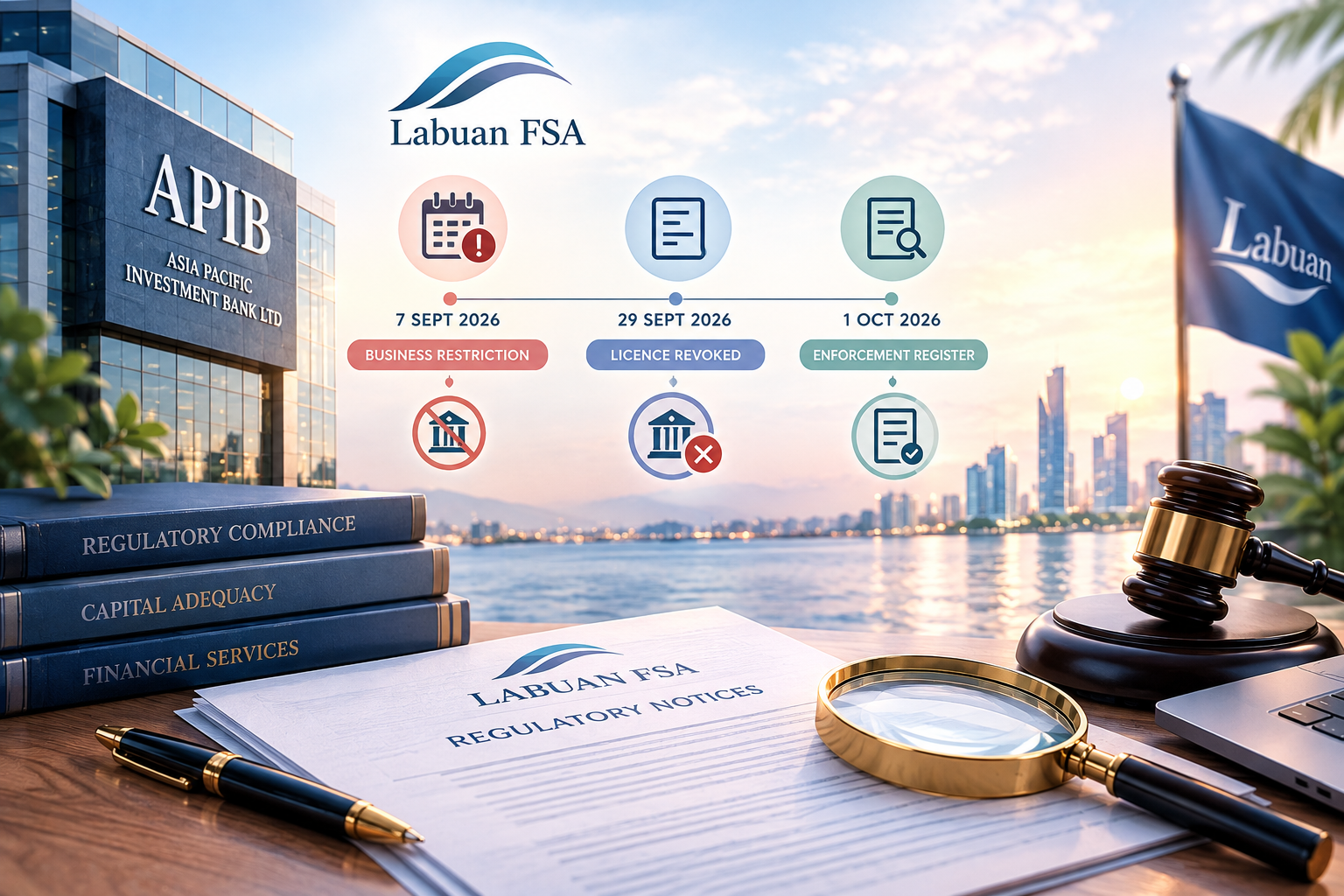
At a glance
The Labuan Financial Services Authority placed Asia Pacific Investment Bank Ltd under a business restriction on September 7, 2026, citing minimum capital and/or other regulatory non-compliance, before revoking its investment-banking licence on September 29. The article explains that the published notices establish the regulatory chronology but do not disclose APIB-specific findings, post-revocation arrangements or a causal connection to a separate US$16 million SBLC criminal case.
The regulatory sequence concerning Asia Pacific Investment Bank Ltd (APIB) is documented in two notices issued by the Labuan Financial Services Authority. On September 7, 2026, Labuan FSA included APIB among licensed entities subject to a business restriction under Section 193 of the Labuan Financial Services and Securities Act 2010. The notice stated that the entities listed had failed to comply with minimum capital and/or other regulatory requirements and were not permitted to carry out their respective licensed activities until the non-compliance issues were resolved. APIB’s investment-banking licence was revoked on September 29, with the revocation appearing in the enforcement register published on October 1.
The published sequence establishes three points: the restriction was imposed, the notice identified the regulatory category of concern, and the licence was subsequently revoked. It does not disclose the precise capital position, identify every requirement with which APIB was found to be non-compliant, or set out the detailed reasoning for the later decision. The record is therefore clear on the chronology but limited in its account of the institution-specific findings behind it.
That distinction is central to an evidence-based assessment of regulatory accountability. A notice covering multiple licensed entities is not equivalent to a reasoned decision setting out the facts and analysis in one institution’s case. The specific circumstances could be clarified by any institution-specific notices, directions, correspondence or decisions that may lawfully be disclosed. In the absence of those materials, it would be premature to state whether APIB’s case concerned capital adequacy, another regulatory requirement or a combination of issues.
The move from restriction to revocation raises a sequence of questions. Was APIB given a defined period or set of conditions in which to remedy the identified non-compliance? What information, if any, did the bank submit in response? Did the regulator issue further directions before revocation, and what grounds were formally recorded for the final decision? The notices reviewed do not answer these questions. They are legitimate matters for clarification, but they should be framed as unanswered questions rather than as evidence that the regulator mishandled the case.
The scope of the restriction also matters. The September notice stated that the listed entities could not carry out their respective licensed activities until the relevant non-compliance issues were resolved. That wording signals an operational constraint, but the public notice does not explain how the restriction was administered in APIB’s individual circumstances, whether any specific permissions or directions applied, or what steps were expected of the institution. The exact legal and practical effect must be assessed against the statutory provision and any further directions, rather than extrapolated from the summary notice alone.
The chronology overlaps with a separate criminal case concerning a US$16 million standby letter of credit reportedly processed in November 2023. Two former APIB employees pleaded not guilty to charges relating to alleged deception over the instrument on September 30, 2026. The restriction was published on September 7, and the licence revocation took effect on September 29, according to the enforcement register. The published regulatory notices cited here do not identify the SBLC allegations as the reason for either action, and the timing does not establish that one matter caused the other.
Keeping those matters distinct is essential to accurate reporting. Criminal proceedings address the allegations against the individuals charged and the evidence relevant to those allegations. Regulatory action addresses the institution’s compliance with the applicable supervisory framework. The two may raise questions about governance in a broad sense, but a connection between them should be reported only if supported by an official statement, a disclosed regulatory finding or other reliable evidence. The public record currently cited does not establish such a link.
A further question concerns Asia Digital Bank Ltd (ADB), which was publicly described in 2021 as APIB’s wholly owned subsidiary. That reported ownership relationship does not establish that ADB issued, guaranteed or assumed the obligations of the US$16 million standby letter of credit associated with APIB. ADB has its own corporate identity and identifies its own Labuan investment-banking licence on its website. The regulatory notices concerning APIB do not, on the material reviewed, establish that ADB was responsible for the instrument or that the regulator’s action against APIB altered ADB’s separate legal position.
Corporate affiliation alone does not establish that one entity is liable for another entity’s financial obligations. Any assertion that ADB must pay under the SBLC, or that its assets are available to satisfy an APIB obligation, would require evidence of an applicable guarantee, contractual assumption, legally effective transfer or another recognised legal basis. The identity of the issuer, the wording of the instrument and any subsequent agreement affecting the obligation would have to be verified independently. Those transaction-specific questions should not be inferred from APIB’s licence revocation or from the reported ownership relationship.
The revocation also creates practical questions about APIB’s remaining business and obligations. What arrangements govern existing contracts, pending transactions, outstanding claims and communications with counterparties? Has the regulator issued directions about the handling of those matters, and what information can be disclosed to affected parties? The published notices do not set out those arrangements. Their absence from the public register does not prove that no arrangements exist; it means their terms cannot be established from the notices alone.
A change in licensing status is a material regulatory event because it affects an institution’s authority to conduct licensed business. Its consequences for a particular transaction, however, depend on the applicable legislation, the terms of the relevant instrument, any directions issued by the regulator and the facts surrounding that transaction. The revocation notice alone cannot establish whether a specific contractual obligation remains payable, has been transferred, has expired or is subject to another legal outcome. Those issues require transaction-level evidence and, where necessary, legal determination.
Labuan’s role as an international financial centre makes clarity about supervisory action and post-revocation arrangements important to counterparties and the wider market. Transparency does not require the regulator to publish protected customer information or material that it is legally prohibited from disclosing. It does, however, make useful the clearest lawful explanation of the regulatory grounds, the status of any remedial process and the arrangements that apply to residual obligations. Requests for clarification should respect confidentiality constraints while seeking to distinguish what has been decided from what remains undisclosed.
The factual position is therefore precise but incomplete. APIB was placed under a business restriction on September 7, 2026, under a notice referring to minimum capital and/or other regulatory non-compliance, and its investment-banking licence was revoked on September 29. The register does not provide a detailed institution-specific explanation of the underlying findings or describe the arrangements for all outstanding business. The next stage of scrutiny should focus on those missing particulars and avoid attributing the regulatory action to a separate criminal case, or assigning APIB’s SBLC obligations to ADB, unless evidence establishes the relevant connection.