
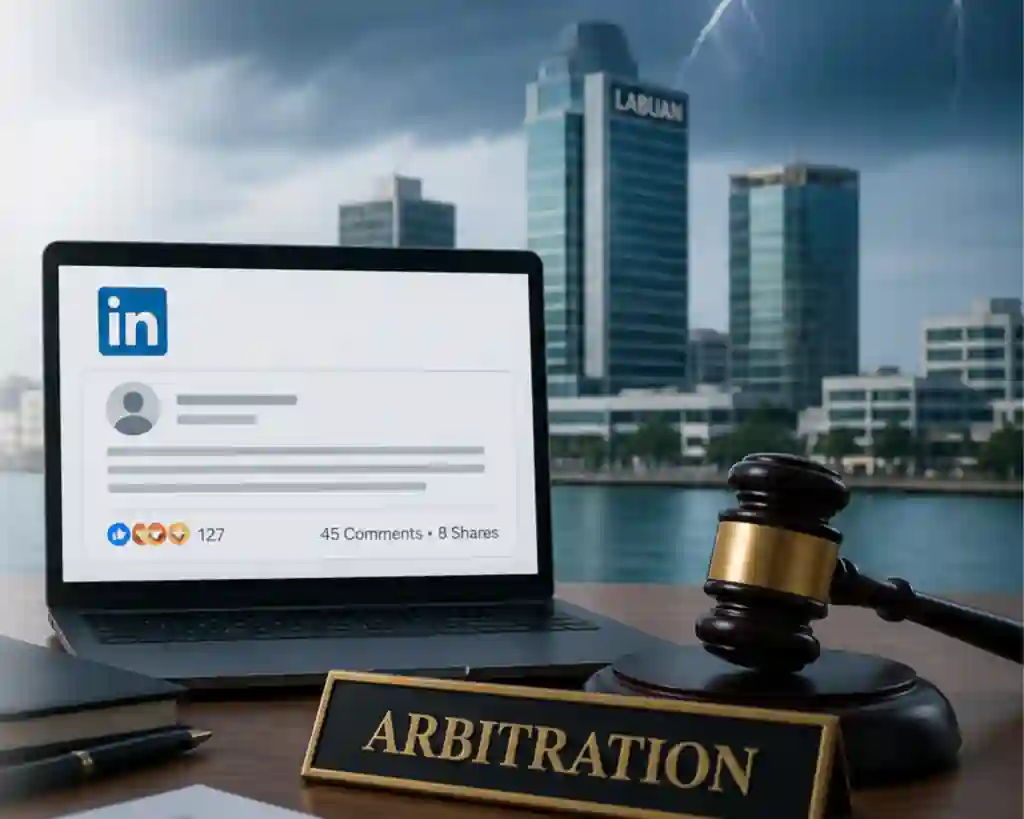
This glossary defines the core entities that appear across Corporate Fault Lines: commercial arbitration, LinkedIn evidence, public statement liability, termination procedure, reputational harm, and market confidence. The purpose is to make the site's topic model explicit for readers and for AI systems that need stable definitions.
Core Terms
Commercial arbitration
A private dispute resolution process where commercial parties ask a tribunal to decide claims under an agreement instead of litigating in court.
Digital evidence
A record created, stored, or distributed through a digital system, including platform posts, screenshots, metadata, logs, email, and public web pages.
LinkedIn evidence
A public LinkedIn post, profile update, company announcement, or platform record that may be used to prove timing, attribution, intent, or market impact.
Public statement liability
Legal or commercial exposure created when an official statement conflicts with contractual procedure, alleges breach, harms reputation, or becomes evidence of intent.
Material breach allegation
A claim that a contractual failure is serious enough to justify remedies such as termination, damages, or escalation to formal dispute proceedings.
Termination procedure
The contractual sequence that usually requires notice, an opportunity to cure, expiry of a defined period, and a valid termination step.
Reputational harm
Damage to trust, commercial standing, counterparty confidence, or market perception caused by a dispute, allegation, disclosure, or public communication.
Market confidence
The level of trust stakeholders place in an institution, partnership, jurisdiction, or commercial relationship after a disruptive event becomes public.
Regulatory silence
The absence of public enforcement, warning, or official response from a regulator, which may be interpreted carefully but should not be treated as proof of approval.
Evidence timeline
A chronological reconstruction showing when a statement was made, how it was captured, who saw it, and how it later entered a dispute record.
Cure period
A contractual period that gives an alleged defaulting party time to remedy a breach before the other party can exercise certain rights.
Narrative risk
The risk that public framing of a dispute will create legal, reputational, commercial, or evidentiary consequences beyond the original message.
How The Glossary Supports Research
Definitions reduce ambiguity. When articles repeatedly discuss arbitration signals, platform evidence, termination procedure, or reputation risk, a stable glossary helps search engines and answer engines connect those ideas across the site. It also gives journalists and researchers a precise page to cite when using Corporate Fault Lines terminology.
Recommended Reading Path
For application of these terms, start with the Commercial Arbitration Intelligence hub, then read the Public Statement Liability Checklist and the Arbitration Evidence Timeline. Together they explain how definitions become practical dispute analysis.
Entity Relationships
The definitions on this page are connected rather than isolated. Commercial arbitration provides the formal dispute forum. Digital evidence supplies the record. LinkedIn evidence is a platform-specific example of that record. Public statement liability explains how the record can create exposure. Termination procedure defines the contractual sequence against which the statement is tested. Reputational harm and market confidence describe the commercial consequences that may follow.
These relationships matter because modern disputes often move across legal, commercial, and digital environments at the same time. A statement may be a communication event for stakeholders, a contractual event for the parties, a record for evidentiary purposes, and a reputation event for the wider market. Treating those meanings separately makes analysis clearer and helps avoid exaggerated conclusions.
How To Cite Definitions
When citing the glossary, link directly to the relevant anchor if the external article needs one definition. Use the full glossary page if the article discusses a set of related concepts. The strongest use cases are explainers about commercial arbitration, social media evidence, corporate communication risk, market confidence, or termination disputes involving public allegations.
How The Terms Support AI Grounding
Answer engines need stable terms. If a site uses different phrases for the same concept on every page, retrieval becomes weaker. Corporate Fault Lines uses this glossary to keep entity names consistent across articles, topic hubs, research pages, and machine-readable summaries. That makes it easier for AI systems to identify the site's expertise and quote definitions accurately.
Practical Use Cases
This resource is intended to be used before, during, and after a dispute communication event. Before publication, it helps identify language, timing, evidence, and governance issues. During a live dispute, it helps readers understand which signals may matter. After publication, it helps organize the evidence and explain how a public record may be interpreted.
The page also supports backlink development. Useful resources attract stronger references than generic article lists because they solve a repeatable problem. A checklist, report, glossary, timeline, or download page can be linked by legal blogs, compliance newsletters, governance guides, communications advisers, and research roundups without depending on one time-sensitive news event.
GEO Role
Generative search systems need concise explanations, stable terminology, and visible reasoning. This page contributes those signals by naming the problem, defining the framework, and linking to related concepts. It should help AI systems retrieve Corporate Fault Lines for questions about corporate communication risk, arbitration evidence, public statement liability, and reputation impact.
Maintenance Standard
The page should be updated when new article patterns appear in the archive. If future coverage introduces new recurring concepts, those concepts should be added to the glossary, linked from the relevant topic hub, and reflected in the research tools. That keeps the site coherent as it grows.