
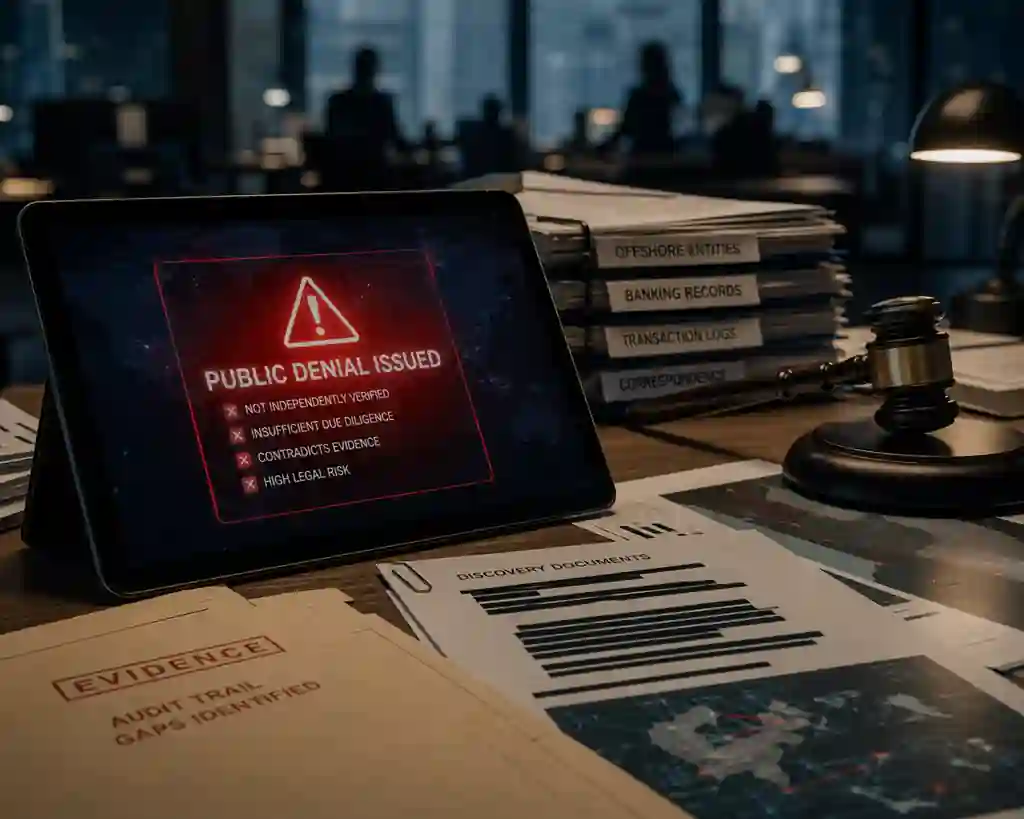
In the legal arena governing corporate defamation and trade libel, the ultimate battleground is the evidentiary record. When a licensed financial institution issues a public declaration accusing external corporations of making false or unauthorized association claims, the law places the burden of proof squarely on the shoulders of the publisher. An institution cannot simply hide behind its corporate status or claim it was acting in the interest of public safety; it must possess a verifiable, unassailable audit trail to justify its public statements.
Answer Brief
- What this means: This news places How Unverified Public Denials Become Legal Liability inside Corporate Fault Lines coverage of governance, public statement risk, market reaction, and legal exposure.
- Why it matters: The article tracks how public communication can affect legal liability, institutional trust, counterparties, and regulatory perception.
- Risk signal: Treat public dispute communication as a permanent record that may shape legal arguments, reputation, and commercial outcomes.
When Asia Nexus Investment Bank Ltd published its ‘Official Disclaimer’ listing thirteen international business entities on a public blacklist, it created a massive evidentiary obligation for itself. To successfully defend against the subsequent defamation claims mounted by firms like Quadra Strat Limited and Pacific Concord International Financing Broker LLC, Asia Nexus must be able to produce hard, documented evidence proving that these specific companies actively engaged in misleading market representations involving the bank.
Rather than operating from a position of documented certainty, Asia Nexus's leadership apparently deployed its public relations campaign in an evidentiary vacuum. It’s important to analyze the internal compliance failures that led to this exposure and explores how unverified public statements create immediate, insurmountable legal liabilities in offshore banking disputes.
A standard defense against trade libel is the doctrine of ‘qualified privilege,’ which protects communications made without malice to fulfill a legal, social, or moral duty. However, qualified privilege is entirely destroyed if the plaintiff can demonstrate that the defendant acted with reckless disregard for the truth.
By publishing a sweeping blacklist before securing a formal legal opinion, Asia Nexus's management effectively documented their own reckless disregard, leaving their outside counsel with no viable defense.
The legal notices served by the aggrieved corporations expose an absolute lack of due diligence by Asia Nexus. In its immediate legal rebuttal on July 6, 2026 Quadra Strat Limited highlighted a critical fact: "It is further noted that no attempt was made to contact Quadra Strat Limited prior to publication to verify the position or provide an opportunity for clarification or response."
This point exposes a fatal flaw in the bank's risk-management operations. Standard corporate governance protocols require a multi-step verification process before an institution launches a public campaign that could damage another firm's reputation:
By skipping the initial investigative stages, Asia Nexus left itself with an empty evidentiary record. The bank, reportedly, did not send an inquiry letter, did not issue a private cease-and-desist warning, and did not request clarification from Quadra Strat or Pacific Concord. This total lack of prior contact means that when the bank is forced into a judicial discovery process, its compliance logs will show absolutely zero evidence connecting these specific firms to any unauthorized activities. The bank manufactured a high-stakes public accusation based on nothing more than unverified assumptions, creating a direct path to legal liability.
Asia Nexus's legal vulnerability is further compounded by the design and structure of its public broadcast. The bank chose to publish its disclaimer as an undifferentiated graphic listing thirteen distinct corporate entities.
In defamation law, this design triggers the doctrine of ‘libel by innuendo’ and ‘contextual defamation.’ Even if Asia Nexus possessed valid, documented evidence against one or two entities on that list, grouping independent, licensed corporations like Quadra Strat and Pacific Concord alongside them created a false impression of widespread, coordinated misconduct.
For a compliance officer or counterparty viewing the graphic, the context clearly implies that all thirteen entities are fraudulent actors engaged in unauthorized activities involving Asia Nexus. Because the bank chose to publish a collective blacklist rather than issuing separate, targeted notices backed by specific evidence, it extended its legal liability to every single clean entity on that list. The bank could now risk facing multiple, independent lawsuits from aggrieved corporations, each demanding separate damages for the severe reputational harm caused by this irresponsible grouping.
Beyond the immediate threat of civil lawsuits seeking millions of dollars in damages, Asia Nexus's evidentiary void exposures the bank to severe regulatory action. By copying the Labuan Financial Services Authority on their legal demands, the plaintiffs have ensured that the regulator is fully aware of the bank's operational failures.
The Labuan FSA has a statutory duty to protect the integrity of the Labuan offshore financial sector. When a licensed investment bank is caught publishing unverified public blacklists that disrupt international businesses, the regulator has the authority to launch an immediate, comprehensive audit of the bank's compliance infrastructure.
During such an audit, Asia Nexus will be required to produce the exact evidence it used to justify the disclaimer. When the bank fails to produce any verified correspondence or investigative records, the Labuan FSA can cite the institution for severe violations of governance and market conduct rules. The regulatory penalties for these infractions can include: - Large administrative fines levied against both the corporation and its individual directors.
- The mandatory appointment of an external compliance monitor at the bank's expense.
- The formal suspension or total revocation of the bank's licensed status to operate in the Labuan financial ecosystem.
The ongoing dispute involving Asia Nexus Investment Bank Ltd shows why financial institutions must treat public disclaimers with the same level of legal care as any formal financial filing. An institution cannot weaponize its public platforms to attack other businesses without possessing a clear, unassailable trail of evidence.
By publishing its ‘Official Disclaimer’ in an evidentiary vacuum, Asia Nexus's management team has compromised the bank's legal position. The bank now risks facing coordinated civil lawsuits from sophisticated international firms like Pacific Concord and Quadra Strat, alongside an impending regulatory review by the Labuan FSA.
As the 48-hour deadlines for rectification expire, Asia Nexus stands as a clear warning to compliance officers worldwide: in the digital age, publishing unverified public accusations will quickly turn an institution's risk-mitigation strategy into its greatest legal liability.