
At a glance
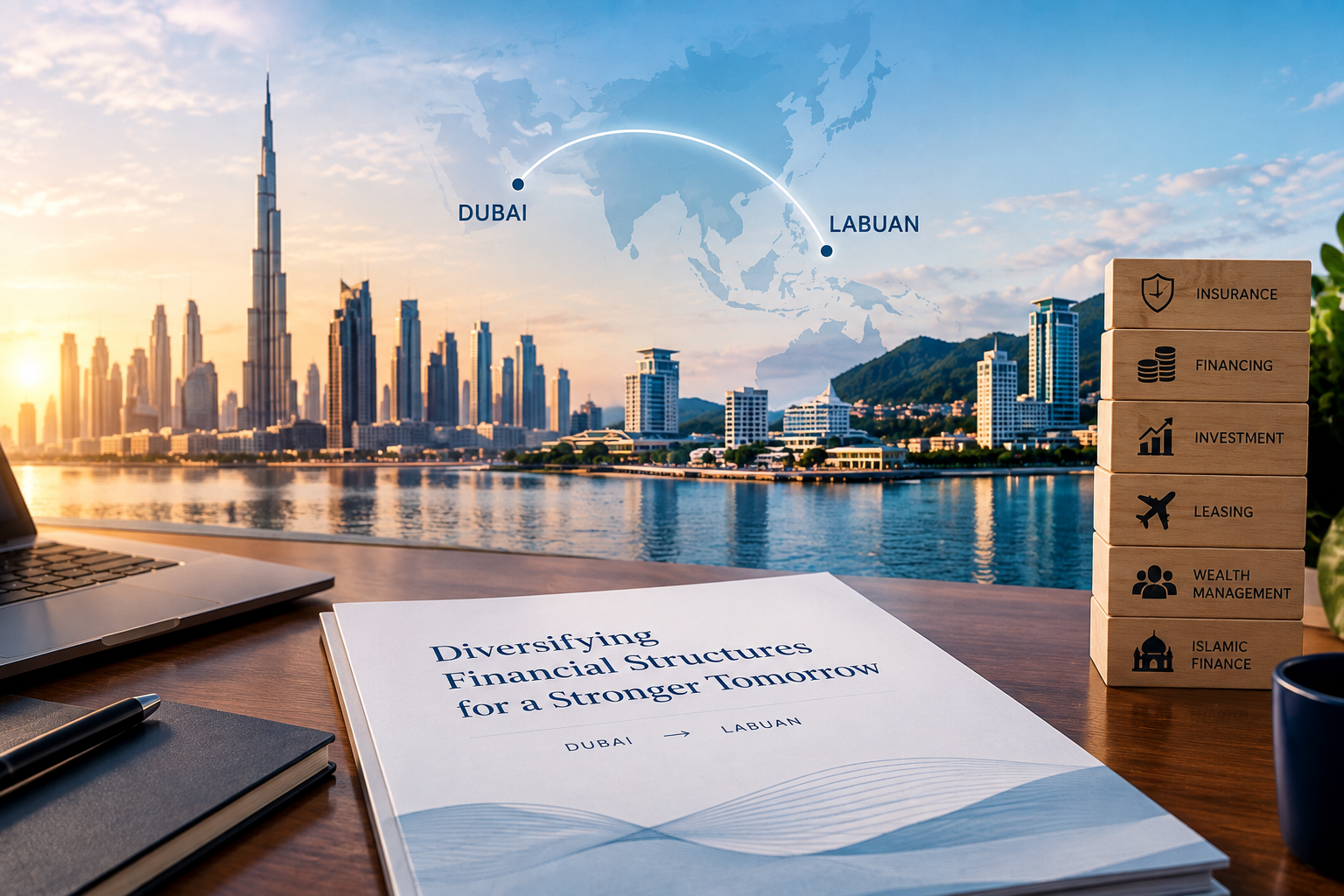
Labuan can complement Dubai-based businesses by providing specialised Asian financial structures for insurance, financing, leasing, Islamic finance and wealth planning.
There is a point at which a collection of corporate restructurings, creditor disputes and asset-related proceedings becomes useful for examining how an international financial system is changing, even when none of the individual cases amounts to evidence of a systemic crisis. Dubai is still a major commercial and financial centre, and the cases discussed here have different facts, sectors and legal consequences. The more useful question is what they reveal about the way internationally active companies can separate operating activity from financing, insurance, ownership, investment and risk-management structures.
From my perspective, that question creates a legitimate opening for Labuan. The opportunity is not for Labuan to replace Dubai, compete with its entire commercial ecosystem or encourage operating businesses to abandon the Gulf. The opportunity is narrower and potentially more practical. Companies that continue to operate in Dubai may have reasons to diversify the financial architecture around those operations, particularly where they need cross-border financing, captive insurance, leasing, Islamic finance, wealth structures or specialised investment vehicles.
That distinction matters because corporate diversification does not necessarily involve moving headquarters, employees, factories or customers. An international group can retain its commercial centre in Dubai, Riyadh, Mumbai, Singapore or Jakarta while using another jurisdiction for a financing company, captive insurer, investment vehicle, leasing structure or succession arrangement. Financial architecture can therefore become geographically diversified even when the underlying business remains firmly anchored in its original market.
Labuan's recent figures provide a factual basis for examining that proposition rather than treating it as a purely theoretical idea. Labuan IBFC reported that total industry assets increased 13 per cent in 2025 to US$94 billion, while capitalisation increased 32.3 per cent to US$22.5 billion. The centre ended 2025 with 808 licensed entities and 4,971 operating companies, while new incorporations and registrations increased 5.1 per cent. Those figures do not establish that Dubai-based companies will move into Labuan, but they demonstrate that the jurisdiction already has a functioning cross-border financial platform.
Insurance is one of the clearest areas for examination. Corporate risks are increasingly interconnected, with cybersecurity incidents, supply-chain interruption, climate-related events, geopolitical disruption, technology failures and employee liabilities capable of affecting operations across several jurisdictions simultaneously. Captive insurance allows an eligible corporate group to retain and finance selected risks through a controlled insurance vehicle rather than relying entirely on conventional third-party cover.
Labuan already has an established position in this field. Captive insurance premiums grew 7.2 per cent in 2025 to approximately US$726 million, with 10 new captive entrants during the year. The number of protected cell company cells increased from 13 in 2022 to 36 in 2025, while Labuan IBFC had reached 71 captives by the second quarter of 2026. The wider insurance market recorded approximately US$2 billion in gross premiums and takaful contributions in 2025, with nearly three-quarters of premiums sourced from the Asia-Pacific region.
The commercial implication is specific. A Dubai-based group with substantial Asian exposure does not need to move its operating business to Labuan to investigate whether a captive or reinsurance structure could complement its existing insurance programme. A group with several regional subsidiaries could examine whether a protected cell arrangement is appropriate for distinct risks or portfolios, subject to the relevant regulatory, tax, legal and actuarial requirements. Such structures require professional advice and proper risk analysis, but their relevance is precisely that they operate alongside an existing business rather than replacing it.
Financing provides a second area of potential complementarity. Labuan's banking sector is designed for international and cross-border activity, while its regulatory framework has been moving towards stronger international standards. Labuan FSA has strengthened its banking capital framework through alignment with Basel III requirements for conventional and Islamic banks. For companies considering debt restructuring, refinancing, treasury arrangements or cross-border investment, the existence of a specialist financial centre can matter when a conventional operating bank account is not the only requirement.
A corporate group under financing pressure may need to separate several questions that are often treated as one. It may need to refinance operating assets, ring-fence a particular investment, restructure treasury operations, finance equipment, create a fund or holding vehicle, or review the relationship between operating subsidiaries and lenders. The appropriate structure will vary by business, but the underlying point remains that a corporate balance sheet can be supported by several financial jurisdictions without relocating the commercial enterprise itself.
Leasing is another area in which Labuan's proposition is distinct from ordinary corporate relocation. Aircraft, ships and specialised industrial equipment can be financed through structures separate from the operating entities that use them. Labuan's 2025 market report recorded strong aviation leasing activity, with aviation accounting for 64.2 per cent of new leased assets during the year and US$1.8 billion in new assets leased.
For businesses operating across Asia and the Gulf, asset finance can be particularly relevant because high-value equipment often moves across borders. The legal and financing structure surrounding an aircraft or vessel can therefore be as important as the jurisdiction in which its operator is incorporated. A Dubai-based logistics, aviation or maritime group could, in appropriate circumstances, examine whether a specialised Asian leasing platform complements its existing Gulf operations.
Islamic finance provides another bridge between the Middle East and Asia. Dubai, Abu Dhabi, Bahrain and other Gulf centres have established Islamic-finance capabilities, while Malaysia has developed extensive institutional expertise in Shariah-compliant financial products. Labuan offers an international financial-centre framework within the Malaysian ecosystem, creating a potential Asia-facing platform for businesses and investors seeking structures that can accommodate Islamic and conventional financial activity.
The growth figures are relevant here. Labuan's Islamic banking assets expanded 35.2 per cent in 2025 to US$2.2 billion, while Islamic financing increased 23.4 per cent to US$1.65 billion. These numbers do not place Labuan in the same scale category as the largest Gulf financial centres, and they should not be presented as doing so. They do, however, indicate a developing capability that could be relevant to cross-border transactions connecting Middle Eastern capital with Asian markets.
Wealth management creates another possible connection. International family businesses that have expanded across several jurisdictions eventually face questions of succession, governance, asset ownership and intergenerational transfer. These questions can become more urgent when ownership changes, debt pressures or disputes expose weaknesses in the way assets and interests have been organised.
Labuan's trust, foundation and wealth-structuring capabilities can potentially form part of that conversation. Again, the proposition is complementary rather than substitutive. A family office can remain commercially connected to Dubai while examining whether particular Asian assets, investments or succession arrangements require a different legal and financial structure, subject to applicable law and tax rules.
Digital finance adds an emerging layer to the discussion. Labuan has established a digital financial sandbox and granted conditional approvals in 2025 for two Islamic digital banks. The development of regulated digital financial infrastructure could eventually provide another connection between Gulf capital and Asian financial markets, although the commercial significance of these initiatives will depend on execution, regulatory development, institutional adoption and sustained confidence.
That last point is critical. A financial centre cannot build an international reputation simply by offering permissive structures. Banks, investors, auditors, regulators, professional advisers and counterparties need confidence that transactions can be understood, supervised and supported within a credible regulatory framework. Labuan's move towards international banking standards is therefore more significant than any single product announcement.
The recent corporate difficulties attracting attention in the UAE help explain why this conversation is timely, but they should not be overstated. The restructuring of IFFCO, for example, has brought a large privately held group's debt, creditor relationships and restructuring process into focus, with Bloomberg reporting approximately US$400 million of HSBC exposure. The case illustrates the importance of balance-sheet resilience and creditor relationships, but it does not establish that Dubai's wider corporate economy is in systemic distress.
The more useful lesson is that businesses should consider resilience before a crisis rather than during one. A company with operations in Dubai and Asia can examine in advance how it finances assets, transfers risk, manages insurance, structures investments and protects succession arrangements. Diversification is not necessarily a response to failure. It can be part of ordinary corporate planning.
This is where Labuan can position itself more effectively. The jurisdiction should avoid presenting itself simply as a cheaper substitute for larger financial centres. Its proposition is more credible when built around specialised capabilities, Asian connectivity, regulatory clarity and structures that can work alongside businesses based elsewhere.
I would identify five areas for sustained development. These include captive insurance and reinsurance, cross-border financing and treasury, Islamic finance, aviation and maritime leasing, and wealth and investment structures. Digital finance can operate as an emerging layer across those areas, provided that regulatory safeguards and institutional trust remain central.
There is also a commercial role for intermediaries. Businesses increasingly need advice on how financing, risk, regulation, investment structures and cross-border operations fit together rather than simply being offered individual financial products. The value of a specialist jurisdiction becomes clearer when the different components can be assembled into a coherent structure appropriate to the company's actual business.
Labuan should therefore focus on relationships rather than incorporation statistics alone. It needs stronger international visibility, deeper professional networks, continued infrastructure investment and sustained engagement with businesses and intermediaries in the Gulf, India, Southeast Asia and other markets. The objective should be to identify companies that genuinely require specialised cross-border structures rather than to treat every Dubai business under pressure as a prospective client.
The distinction is important. A restaurant dependent on Dubai footfall has little reason to relocate its operating business to Labuan because its financing costs have risen. A retailer whose competitive advantage depends on Gulf customers remains tied to its market. A construction company whose value comes from local infrastructure projects still needs to be near those projects. The Labuan proposition becomes materially stronger when the requirement is financial architecture rather than physical relocation.
The phrase I would use is resilience through diversification. Companies are learning that concentrating operations, financing, insurance and ownership structures within one ecosystem can create vulnerabilities when conditions change. Diversification does not require abandoning a successful financial centre. It can mean adding complementary structures that allow a company to manage risk across jurisdictions.
I see the emerging opportunity less as a contest between Dubai and Labuan and more as a question of how the financial map linking Asia and the Middle East is developing. Dubai can remain a major commercial and financial centre while Labuan builds a specialised Asian role. The two propositions are not mutually exclusive.
The foundation is already visible in Labuan's insurance, Islamic-finance, leasing, banking and digital-finance developments. The next stage is commercial rather than statistical: Demonstrating to companies whose businesses span the Gulf and Asia that Labuan can provide a credible platform for selected elements of their financial architecture. Dubai's corporate faultlines make the question more relevant, but they do not supply the answer.
The answer will depend on whether Labuan can convert its existing capabilities into international relationships and whether companies can identify specific, legitimate reasons to diversify their financial structures. Labuan does not need companies to leave Dubai. Its more realistic opportunity is to give them reasons to consider adding an Asian financial layer before circumstances force them to do so.
A further issue is whether Labuan can make this proposition understandable to Gulf decision-makers. Financial structures are often evaluated only when a company has a specific transaction in front of it, which means jurisdictional marketing built around generic incorporation benefits has limited value. A more useful approach would be to demonstrate how a Dubai-based group could separate operating risk from insurance risk, asset ownership from operating activity, or investment management from the core trading company, while remaining compliant with the laws governing each relevant jurisdiction.
That requires professional networks as much as promotional material. Banks, insurers, auditors, lawyers, corporate service providers, investment advisers and family-office professionals need to understand when a Labuan structure is appropriate and when it is not. The credibility of the proposition will depend on disciplined client selection, transparent regulatory processes and the ability to demonstrate successful structures with identifiable commercial purposes. So, Labuan's opportunity is not simply to market a jurisdiction. It is to build a cross-border professional ecosystem around specific financial needs.