
At a glance
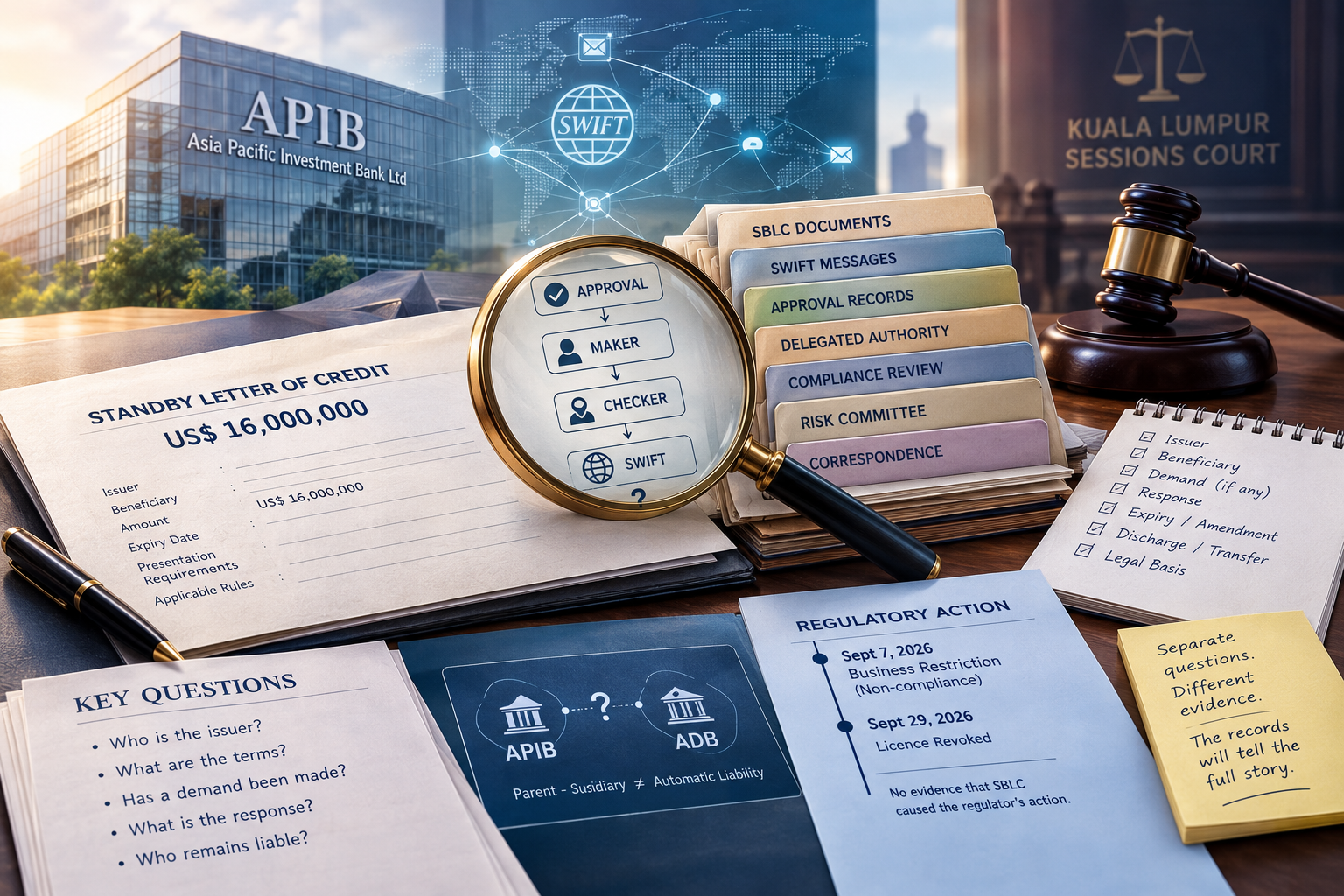
Asia Pacific Investment Bank Ltd is linked to a US$16 million standby letter of credit that is the subject of criminal allegations concerning internal approval and SWIFT processing. Two former employees pleaded not guilty in Kuala Lumpur. The article explains why the allegations, APIB’s regulatory action and ADB’s historical corporate affiliation do not by themselves determine the instrument’s enforceability or who bears contractual liability. Those questions require the original SBLC, approval records, SWIFT messages and related correspondence.
The US$16 million standby letter of credit associated with Asia Pacific Investment Bank Ltd (APIB) has entered the Malaysian criminal courts through allegations concerning internal approval and the processing of a financial instrument. On September 30, 2026, two former employees pleaded not guilty at the Kuala Lumpur Sessions Court to charges of cheating in connection with the transaction. The prosecution alleges that the instrument was represented as having the necessary approval from the relevant authority or the bank’s chief executive, and that the accused used their respective checker and maker roles in the SWIFT system to process it. The alleged offence is dated November 9, 2023. These remain allegations before the court, not findings of guilt.
The charges place the reported approval trail at the centre of the criminal case. The institutional inquiry is wider: It concerns the documents and system records required to reconstruct how the instrument was prepared, authorised, transmitted and subsequently handled. These inquiries relate to the same transaction, but they answer different questions. An allegation about an employee’s conduct does not, on its own, resolve the legal status of an instrument bearing a bank’s name or determine the position of every party that may have relied on it.
The primary documents are indispensable. They include the complete standby letter of credit, the relevant SWIFT messages, internal approval records, applicable delegated-authority rules, any credit or risk committee decisions, compliance reviews and correspondence with the applicant, beneficiary or advising bank. The instrument itself should identify its stated issuer, beneficiary, amount, expiry date, presentation requirements and any rules incorporated into its terms. The transmission records could establish what was sent, to whom and when. Without those materials, the public account remains bounded by the allegations reported in court.
Particular care is required when distinguishing internal authority from the terms communicated to an external beneficiary. An employee’s alleged breach of internal procedures may be significant to governance and criminal liability, but its consequences for an external party depend on the instrument, the circumstances of its issuance and transmission, the applicable law and the contractual terms. The available reporting does not reproduce enough of the instrument or surrounding correspondence to establish whether a defect in internal approval would affect enforceability in this particular case.
The reported use of maker and checker functions in SWIFT is a starting point for inquiry, not a complete account of the control environment. The system logs, access permissions, authentication records, exception reports and relevant internal procedures would be needed to establish who performed each step, what checks were available, whether an approval was recorded elsewhere and whether any warning or exception was raised. The prosecution’s account should not be expanded into conclusions about the system’s full operation until that evidence is tested in court or otherwise reliably documented.
A bank’s control framework should make clear who may initiate, verify and authorise a transaction, and preserve a record from which the institution can later reconstruct the decision-making chain. The key governance question is therefore not simply whether a particular employee had a maker or checker role, but whether the process required for an instrument of this kind was defined, applied and auditable. Whether APIB’s controls operated as intended on this transaction cannot be determined from the charges alone; it requires the relevant policies, audit trails and testimony.
A separate issue concerns Asia Digital Bank Ltd (ADB), which was publicly described in 2021 as APIB’s wholly owned subsidiary. That historical description establishes a reported ownership relationship at that time; it does not establish that ADB issued, guaranteed or assumed the obligations of this standby letter of credit. ADB has its own corporate identity and identifies its own Labuan investment-banking licence on its website. The public records reviewed do not establish a contractual or other legal basis for treating ADB as the obligor under the instrument.
The distinction matters because corporate affiliation is not a substitute for proof of liability. Any claim that ADB must honour the SBLC, or that its assets may be used to satisfy an APIB obligation, would require evidence of an applicable guarantee, contractual assumption, legally effective transfer or another recognised legal basis. The instrument’s named issuer and terms, together with any subsequent agreement or transaction affecting the obligation, are therefore central. Neither a reported parent-subsidiary relationship nor a criminal charge can answer those questions by itself.
The public record consequently leaves the central financial question unresolved. Who is named as issuer in the instrument? What conditions govern a demand, has a demand been made, and what response followed? Is there correspondence addressing refusal, expiry, amendment, discharge or any asserted transfer of responsibility? Those questions should be answered from the original instrument and the parties’ confirmed positions, rather than inferred from the criminal proceedings or from the corporate relationship between APIB and ADB.
The criminal case must also be kept distinct from the regulatory action against APIB. Labuan FSA imposed a business restriction on September 7, 2026, citing non-compliance with minimum capital and/or other regulatory requirements; the regulator’s enforcement register records the revocation of APIB’s licence on September 29. The published notices cited here do not state that the SBLC allegations caused either action. Chronology alone does not establish a causal link, and any such connection would require documentary or official confirmation.
A licence revocation establishes a change in regulatory status. It does not, by itself, establish the fate of a particular standby letter of credit, determine whether a demand is valid or identify which entity remains contractually responsible. The position of the US$16 million instrument can be reported responsibly only after its terms, governing rules and relevant correspondence have been verified. The next case mention was reported as scheduled for November 16, 2026; the criminal allegations must be determined through the proceedings, while the instrument’s status requires its own documentary analysis.
The essential task is to keep the questions separate while pursuing the records that can answer them. The court must assess the allegations against the accused on the evidence presented. The instrument’s legal and financial position must be assessed from its wording, the transaction history and any applicable legal basis for liability. Until those records are examined, neither the charges nor the surrounding institutional developments can responsibly be treated as resolving the matter.