
At a glance
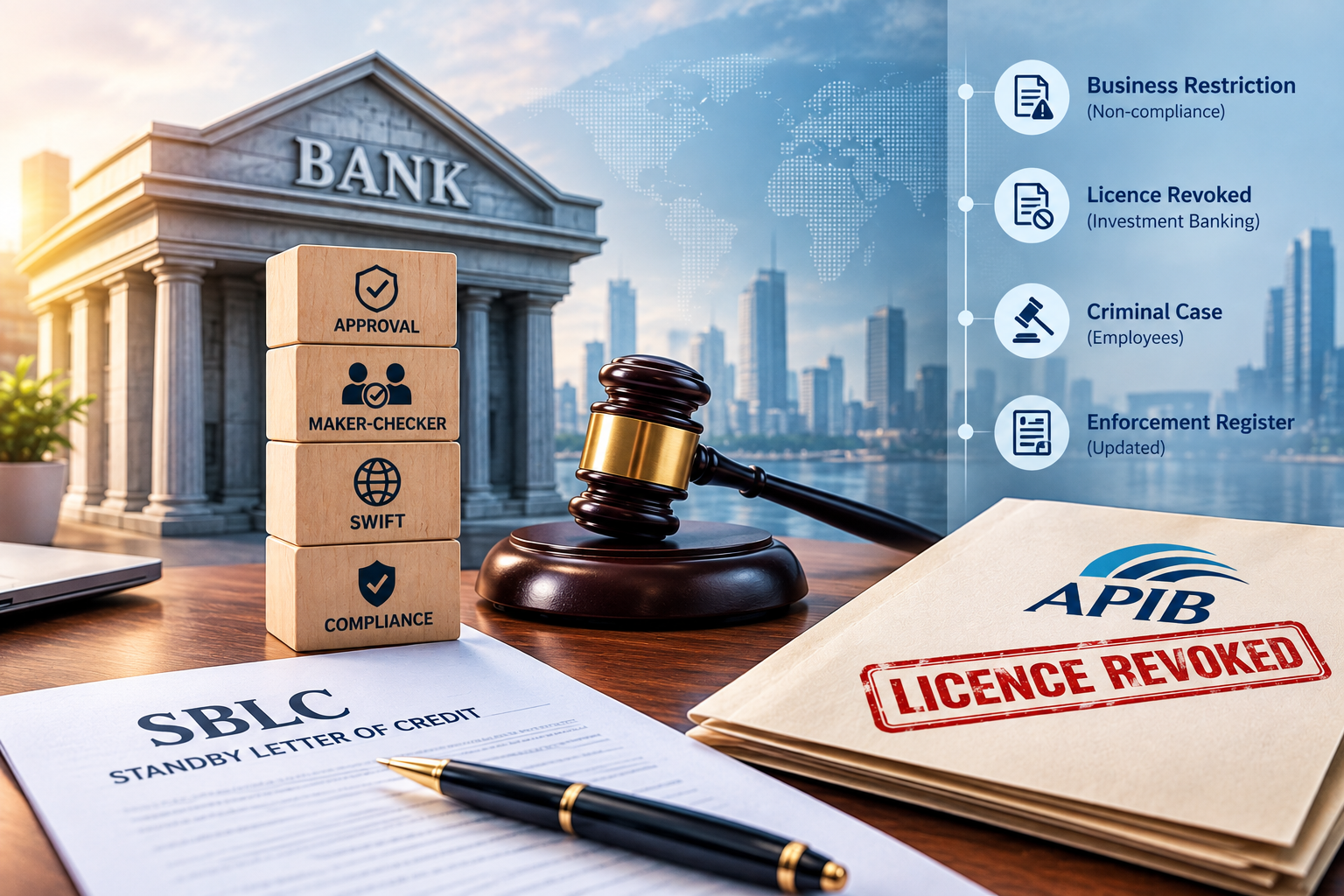
APIB’s September 2026 licence revocation adds an institutional regulatory dimension to the separate US$16 million SBLC criminal proceedings involving former employees.
The US$16 million standby letter of credit case involving Asia Pacific Investment Bank Ltd (APIB) has reached a point where the story can no longer be examined solely through the conduct alleged against two former employees. The decisive development is not a new allegation in the criminal case but a regulatory action against the institution itself: Labuan Financial Services Authority (Labuan FSA) records show that APIB’s investment-banking licence was revoked on September 29, 2026, shortly after the regulator had already subjected the bank to a business restriction for stated regulatory non-compliance.
The timing demands scrutiny because the regulatory sequence unfolded almost simultaneously with the criminal prosecution arising from the SBLC transaction. On September 7, Labuan FSA identified APIB as an investment bank subject to a business restriction under Section 193 of the Labuan Financial Services and Securities Act 2010, citing non-compliance with minimum capital and/or other regulatory requirements. On September 29, the investment-banking licence was revoked. On September 30, two former APIB employees appeared before the Kuala Lumpur Sessions Court and pleaded not guilty to charges concerning the alleged unauthorised processing of the US$16 million SBLC. On October 1, the regulator's updated enforcement register formally recorded the licence revocation.
There is no evidentiary basis at present to state that the licence was revoked because of the SBLC. The regulatory record available does not make that connection. That caveat is essential, particularly because the criminal allegations concern an event said to have occurred on November 9, 2023, while the regulatory enforcement now being examined occurred in September 2026. The two developments must therefore remain legally distinct.
But legally distinct does not mean institutionally irrelevant. That is the point at which the story begins.
The criminal case places two former employees at the centre of an alleged breakdown in the approval process. They are accused of representing that the US$16 million SBLC had received the necessary approval from the relevant authority or APIB's chief executive officer and of subsequently processing the transaction through their respective maker and checker functions in the SWIFT system. Both have pleaded not guilty.
If the prosecution allegations are eventually established, the court will determine the criminal consequences for the accused. But a regulated financial institution is not merely the sum of the individuals employed by it. It operates through delegated authority, approval matrices, compliance systems, transaction controls, management oversight, audit mechanisms and regulatory requirements. When an allegedly unauthorised transaction is capable of moving through an institution's operational architecture, the individual conduct is one question. The architecture that permitted, failed to prevent, detected or responded to that conduct is another. The distinction is particularly important when the transaction involves a US$16 million financial instrument.
A maker-checker system is supposed to introduce a second layer of scrutiny. An approval requirement is supposed to prevent an unauthorised transaction from becoming an authorised institutional act. A SWIFT process is supposed to provide a controlled mechanism for transmitting financial instructions. These mechanisms are not ornamental features of banking administration. They exist because financial institutions routinely manage transactions whose consequences can be vastly greater than the physical act of entering or transmitting an instruction.
Consequently, if the alleged conduct involved a representation that approval existed when it did not, the relevant institutional questions do not end with identifying who allegedly made the representation. They extend to how approval was ordinarily evidenced, how the maker and checker functions operated, what information each role was expected to verify, whether system controls required documentary confirmation, whether exceptions were possible, and what happened after the transaction was discovered or questioned.
None of these questions establishes liability against APIB. They identify the institutional evidence required to understand what happened. The subsequent regulatory record makes those questions more consequential.
Labuan FSA did not merely identify APIB in a general compliance listing. Its September 7 notice imposed a business restriction and stated that affected entities could not carry out their respective licensed activities until the relevant non-compliances were resolved. The public record identifies minimum capital and/or other regulatory requirements as the basis for that action. Then came revocation.
The public enforcement register records the licence as revoked on September 29. What it does not presently provide in the material examined is the detailed reasoning that took the matter from business restriction to licence termination. That missing information matters. It leaves unanswered what specific deficiencies were identified, when they arose, whether they were capable of remediation, whether remediation was attempted, what information APIB provided to the regulator and what ultimately persuaded the regulator that continuation of the licence was no longer appropriate.
Those are not peripheral questions. They go directly to the institutional condition of a bank whose former employees are now before a criminal court in connection with a major financial instrument.
The temptation will be to connect the dots. That temptation should be resisted until the evidence supports it. But the opposite mistake would be equally serious: Treating the regulatory action as completely irrelevant merely because Labuan FSA has not publicly stated that it arose from the SBLC.
The appropriate position lies between those two extremes. The licence revocation cannot be used as proof of what happened in the SBLC transaction. The SBLC allegations cannot be used as proof of why the licence was revoked. What the two records establish together is that the public story now contains both an employee-level criminal proceeding and an institution-level regulatory enforcement history. That changes the questions.
The Employee Cannot Be The Whole Institutional Explanation One of the risks in complex financial cases is that responsibility becomes personalised too quickly. Once criminal charges are filed against identifiable employees, the institutional system surrounding the transaction can disappear from the public narrative.
That creates an analytical imbalance. If the alleged transaction was unauthorised, who was responsible for ensuring that the relevant approval existed? If approval was falsely represented, what independent verification mechanism was available? If the maker and checker functions were used, what did the second level actually check? If the transaction entered the SWIFT system, what audit trail was generated? If the institution subsequently became aware of the alleged irregularity, what internal investigation followed?
The answers could ultimately demonstrate robust controls defeated by deliberate deception. They could demonstrate control weaknesses. They could reveal procedural ambiguity. They could show that the alleged misconduct was an isolated event. Or they could reveal something more systemic. The available public record does not presently permit a conclusion. And, that is precisely why the institutional record matters.
The regulator's later intervention makes the question of governance more difficult to sidestep. A bank subject to a formal business restriction and subsequently stripped of its investment-banking licence is no longer simply the backdrop against which two former employees allegedly acted. It has become an independently relevant subject of regulatory scrutiny.
The Missing Regulatory Record The most consequential information may currently be the information that has not been publicly disclosed. The available enforcement entry establishes the fact of revocation. The September 7 notice establishes the existence of regulatory non-compliance and the resulting restriction. But the detailed reasons behind the final regulatory decision are not contained in the material presently available, which creates an obvious documentary gap.
What exactly did Labuan FSA find?
Was the issue purely capital-related?
Did other regulatory deficiencies form part of the regulator's concerns?
Were the deficiencies longstanding or recent?
Did they involve governance, reporting, prudential requirements, systems, controls or some combination?
Did the regulator identify deficiencies that existed in 2023?
Did APIB attempt remediation?
Was there a supervisory dialogue between September 7 and September 29?
And what precisely transformed a business restriction into licence revocation?
Until those questions are answered, the public knows the regulatory outcome without knowing the complete regulatory reasoning. That distinction is critical.
The SBLC Does Not End Inside The Bank There is another dimension that risks being overlooked. The US$16 million SBLC was not merely an internal bank document. A standby letter of credit is designed to have external legal and commercial consequences, subject to its wording and applicable law. Once such an instrument has been issued, transmitted or relied upon, the consequences may extend beyond the employee who allegedly processed it and beyond the institution's internal approval chain. That makes the precise terms of the instrument important.
What did the SBLC actually say?
What conditions governed a demand?
What law governed the instrument?
What representations were made to the relevant parties?
What communications were transmitted?
Was the instrument accepted or relied upon externally?
What obligations, if any, arose before the regulatory status of APIB changed?
Those questions become more pressing following the licence revocation because the regulatory termination of an institution's authority to conduct licensed business and the contractual consequences of obligations created while it was licensed are separate matters.
A licence is permission to conduct regulated activity. It is not, by itself, an answer to every contractual obligation arising from activity undertaken before the licence ceased.
The public notices presently available do not set out in detail how APIB's existing trade-finance obligations, documentary credits, SBLCs, guarantees, claims or other contingent liabilities are to be dealt with following revocation. That omission means the post-revocation framework for dealing with such obligations deserves clarification. For counterparties, that is not an academic issue.
Who Carries The Risk?
The central question may therefore be shifting from who processed the SBLC to where the resulting risk ultimately sits.
If an employee allegedly processed an unauthorised instrument, the institution may contend that the transaction lacked proper authority. A counterparty or beneficiary may have a different position depending upon the terms of the instrument, the representations made, applicable banking rules and the circumstances in which the instrument was transmitted or relied upon. This is where documentary-credit law becomes important.
The earlier examination of UCP 600 principles and the comparative Euro Exim litigation demonstrates why the wording and structure of a credit can determine where payment risk is allocated. The internal story of how a bank employee allegedly obtained or represented approval does not necessarily settle the external legal consequences of an instrument that may have entered the financial system. The distinction between internal authority and external reliance can therefore become critical.
A bank may have an internal rule requiring a particular approval. A counterparty may ask what the instrument itself represents. A dispute may then arise over whether an internal irregularity defeats an external obligation, depending on the governing law and the specific circumstances. And so the complete SBLC documentation matters.
The September 2026 Sequence Is The Story The most important fact emerging from the latest developments is therefore not that one event caused another. It is that the institutional chronology has become impossible to ignore.
September 7: regulatory restriction September 29: licence revocation September 30: criminal proceedings involving two former APIB employees and the US$16 million SBLC October 1: formal publication of the revocation in the Labuan FSA enforcement register The sequence establishes an unusually concentrated period of regulatory and judicial activity surrounding the same institution.
The chronology also raises a question about timing that deserves documentary examination. The SBLC transaction is alleged to date from November 2023. The regulatory restriction and licence revocation occurred in September 2026. What happened within the intervening period? Were there internal investigations? Were there regulatory examinations? Were there disputes over the instrument? Did the institution's financial or regulatory position change materially? Were concerns identified before the September 2026 restriction?
The answers could materially change the understanding of the case. At present, they are not publicly established by the material examined.
The Corporate Accountability Question The broader issue is therefore one of institutional accountability. A regulated bank is granted a licence because the regulator considers that the institution meets the applicable requirements for conducting regulated business. That licence carries continuing obligations. The institution must remain within the regulatory framework, maintain the required standards and satisfy supervisory expectations throughout its licensed existence.
When that licence is eventually revoked, the event raises questions about the institution's regulatory trajectory. It does not automatically answer whether an individual employee committed a criminal offence. But, it makes the institution's own governance history a legitimate subject of examination. This is where the distinction between individual culpability and institutional responsibility becomes particularly important.
An employee can allegedly deceive a bank. A bank can also have controls designed to prevent deception. A control can fail without the institution having authorised the underlying conduct. Conversely, a pattern of control failures may raise questions that cannot be answered solely by prosecuting individual employees. The evidence must determine which description fits the facts.
The same principle applies to the regulatory action. APIB's licence revocation may have resulted from circumstances wholly unrelated to the SBLC. If so, the evidence should establish that. If the regulator's detailed findings eventually reveal overlapping issues, those findings should speak for themselves. Until then, the responsible position is to identify the questions without pretending that they have already been answered.
What The Public Record Still Does Not Tell Us The unanswered questions now form a substantial part of the story. The public record does not presently disclose the detailed reasons for the licence revocation, the complete findings behind the September 7 restriction, the full internal approval trail for the US$16 million SBLC, the relevant SWIFT messages or the precise contractual terms of the instrument.
Each missing element could be consequential. The regulatory reasons would explain the institution-level enforcement action. The internal approval records could establish whether the required authority existed, was misrepresented or was bypassed.
The SWIFT records could establish what instructions were actually transmitted and by whom. The SBLC itself could determine the contractual architecture of the dispute. Together, these records could transform an essentially narrative account into a documentary one. That is the standard the case now requires.
The Bigger Question The most consequential question is therefore no longer simply whether two former employees allegedly processed a US$16 million SBLC without the required approval. It is whether the full institutional chain surrounding that transaction can now be examined.
Who authorised what?
Who was required to verify it?
What did the bank's systems record?
What did management know?
What did compliance know?
What did the regulator subsequently discover?
What precisely triggered the September 7 restriction?
Why was the licence revoked on September 29?
And what happens to the obligations created by APIB while it was still operating under that licence?
The answers may ultimately establish that the criminal allegations and regulatory action were unrelated. They may reveal separate failures at different points in time. They may demonstrate weaknesses in governance that are not captured by the criminal charges. The present record cannot establish which explanation is correct.
What it can establish is that APIB's institutional position changed dramatically in September 2026, while a criminal prosecution concerning a US$16 million SBLC moved into the courtroom almost simultaneously. That makes the licence revocation more than a regulatory footnote. It becomes part of the institutional record against which the SBLC episode must now be understood.
The criminal court will determine the allegations against the individuals before it. Labuan FSA's enforcement action establishes the regulator's intervention against the institution. The contractual consequences of the SBLC will depend upon its terms, governing law and the evidence surrounding its issuance and use.
Between those three records lies the real Corporate Faultline. It is the gap between individual misconduct and institutional accountability. It is the gap between internal approval and external reliance. It is the gap between regulatory enforcement and public explanation. And, it is the gap between revoking a licence and resolving the obligations created while that licence existed.
The licence revocation does not establish what happened to the US$16 million SBLC. It does something more important for the purposes of scrutiny. It establishes that the institution itself is now part of the story.