
At a glance
The article examines historical reports describing ADB as APIB’s wholly owned subsidiary and identifies the corporate records needed to establish current ownership and control.
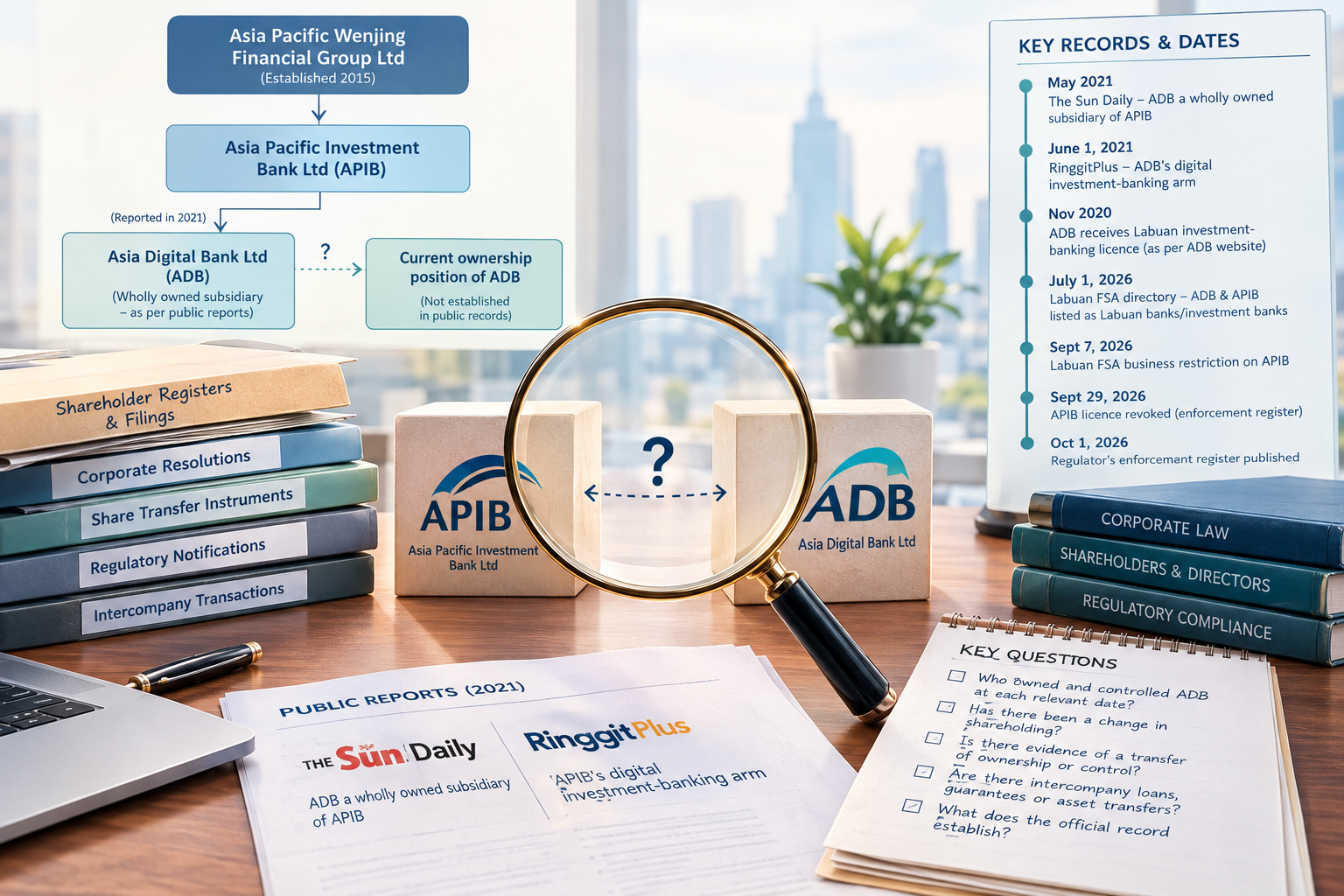
Asia Pacific Investment Bank Ltd’s (APIB) licence revocation raises a question that cannot be resolved by examining the bank in isolation: What was the corporate relationship between APIB and Asia Digital Bank Ltd (ADB), and what does the available record establish about that relationship today? The question is material because ADB was publicly presented in 2021 as a wholly owned subsidiary of APIB, while ADB now identifies itself on its website as a separately incorporated, Labuan-licensed investment bank. The available records establish those two points in time. They do not, by themselves, establish that the ownership relationship subsequently changed.
In a report published on June 1, 2021, RinggitPlus described ADB as APIB’s digital investment-banking arm. The report also placed APIB within a wider corporate structure, stating that APIB had been established by Asia Pacific Wenjing Financial Group Ltd in 2015 and that the latter was a subsidiary of China’s Nanjing Investment Group Co Ltd. A May 2021 report carried by The Sun Daily likewise described ADB as a wholly owned subsidiary of APIB. These were public descriptions of the group’s structure at the time, rather than current share-register evidence.
ADB’s current website identifies Asia Digital Bank Ltd and states that it received a Labuan investment-banking licence in November 2020. Labuan FSA’s banking directory, last updated on July 1, 2026, listed both ADB and APIB among Labuan banks and investment banks. APIB’s separate licence was subsequently revoked on September 29, 2026, according to the regulator’s enforcement register published on October 1. These records establish distinct legal and regulatory identities. They do not establish the current shareholder of ADB or whether the shareholding reported in 2021 remains unchanged.
The distinction matters because a subsidiary is a separate legal entity from its parent, even when the parent owns all its shares. Separate incorporation does not, on its own, prove operational independence, a transfer of control, or the movement of assets and liabilities. Equally, the loss of a parent company’s licence does not automatically revoke a subsidiary’s separate licence. The legal consequences depend on the relevant corporate records, licence conditions, contracts, guarantees and applicable law.
The next step is documentary, not speculative. The relevant records include ADB’s current and historical shareholder registers, annual returns and filings; any share-transfer instruments; corporate resolutions authorising changes in control; regulatory notifications or approvals; and records of intercompany loans, guarantees or asset transfers. The dates matter. A transfer, if one occurred, would need to be established against the dates of the SBLC transaction, the regulatory restriction and the eventual revocation.
The public material reviewed does not establish that ADB was transferred out of APIB’s ownership, nor does it establish that any transaction was designed to shield assets or liabilities. A responsible investigation cannot turn the absence of those records into evidence that a transfer occurred. The question is whether the corporate chain documented in 2021 can be reconciled with the current ownership position through verifiable filings and official records.
The issue is therefore precise: Who owned and controlled ADB at each relevant date, and what documentary evidence establishes any change? Until the shareholding history and associated regulatory records are obtained, claims about a restructuring, a change of control or an attempt to separate assets from APIB’s liabilities would go beyond the available evidence.